Our role
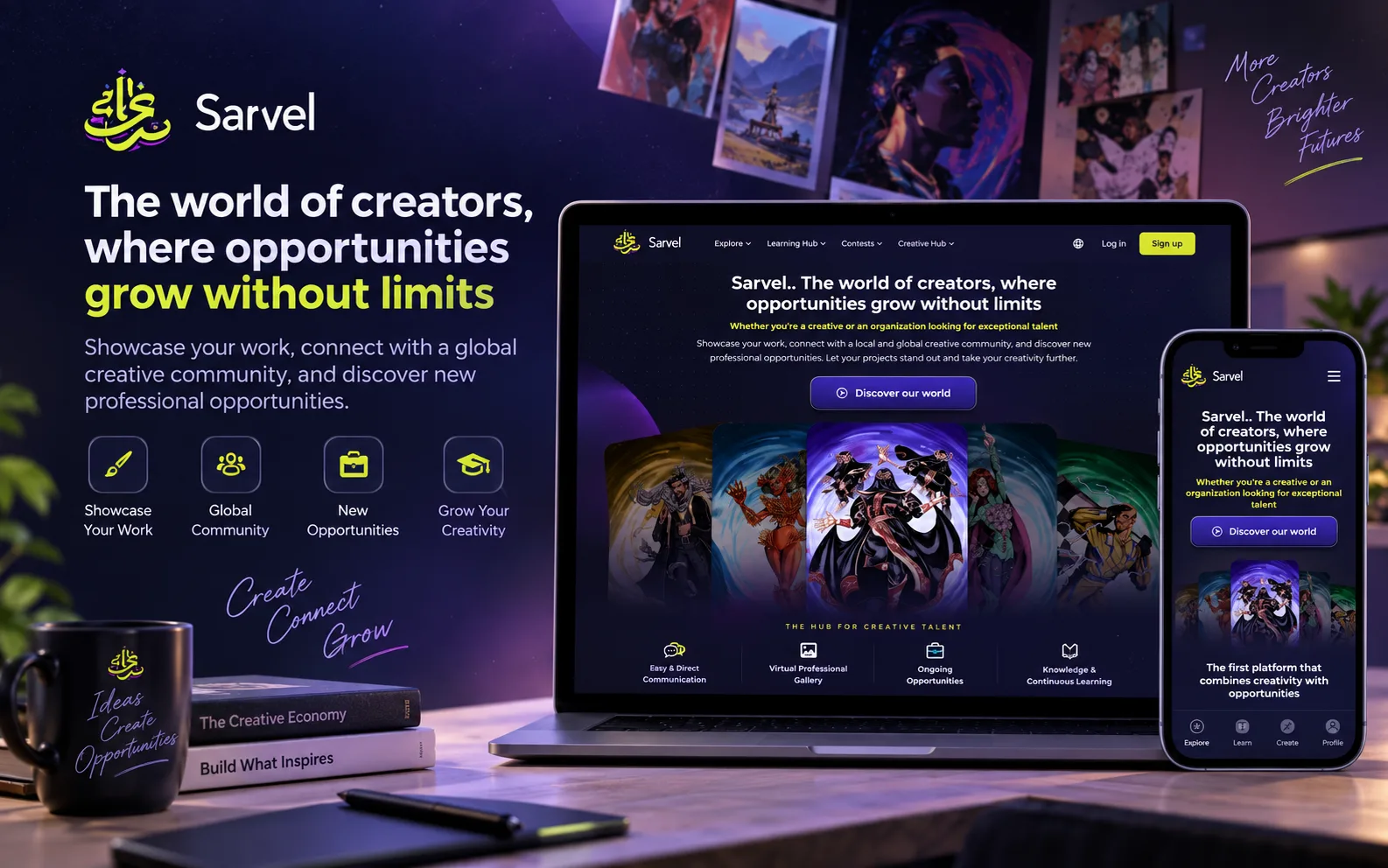
Sarvel came to us wanting more than a portfolio site. We architected a platform where the work, the audience and the commercial opportunity share one data model, then built the moderation and audit infrastructure that lets a creative community grow without becoming unmanageable.
Most portfolio platforms stop at the portfolio. Sarvel connects the work to what comes after it. We modelled artwork as a single polymorphic entity carrying a many-to-many discipline taxonomy, commercial pricing and social engagement on the same record, so one publishing flow serves a sculptor, a game artist and a comic illustrator without forking the product. On top of that sit the surfaces that make the platform worth returning to between commissions: an explore feed, a learning hub, contests and a creative hub. Underneath sits the part nobody markets but every public community needs. Reports are polymorphic across artwork, comments and threads, each carrying reporter, payload and resolution state into a single triage queue. Every privileged action is written to an append-only activity log. Access is role-segregated between members and administrators, and the whole back office is a purpose-built console rather than a database client and good intentions.
A Portfolio That Leads Somewhere
Eleven Disciplines, One Schema
Painting, sculpture, drawing, calligraphy, 2D and 3D art, animation, game art, comics and manga, graffiti and mixed media carry different conventions but had to share one publishing pipeline. We resolved it with a many-to-many taxonomy rather than per-discipline models, so the catalogue stays uniformly filterable and a twelfth discipline is a data migration, not a rebuild.
Discovery Has Two Audiences
A creator browsing for inspiration and an organisation scouting for a commission want opposite things from the same index. Sorting and filtering were built over engagement, recency and discipline simultaneously, so one catalogue serves both intents without splitting into two products.
Community Is the Value and the Liability
Reactions, comments and threads are what compound retention, and they are also the attack surface. We treated trust and safety as a launch requirement rather than a post-incident retrofit.
How We Built It
Polymorphic Moderation
A single reportable abstraction spans artwork, comments and threads, so one triage queue covers every user-generated surface. New content types inherit moderation automatically instead of shipping with a blind spot.
An Append-Only Audit Trail
Administrative actions and authenticated sessions are journalled immutably. That is what makes a takedown defensible months later, and what turns a disputed decision into a lookup rather than an argument.
Role-Segregated Access
Member and administrator identities are separated at the boundary, with credential recovery, email verification and code-based confirmation flows, so elevated capability is never one compromised password away.
An Operator Console, Not a Dashboard
Six modules covering catalogue, membership, administration, triage, audit and time-windowed analytics, so the team runs Sarvel at full capability without an engineer in the loop.
What We Delivered
The Professional Gallery
Multi-discipline portfolio listings with commercial pricing, indexed for discovery by discipline, recency and engagement.
The Opportunity Layer
Direct contact between creators and commissioning organisations, with the learning hub and contests that keep members engaged between briefs.
The Trust Stack
Unified report triage with resolution states, immutable activity journalling and segregated administrative access.
Operational Intelligence
Time-windowed aggregation across views, reactions, comments and reports, so community health is observable rather than anecdotal.