Our role
We built both halves of a hosting business: the commercial front end that sells and provisions, and the customer dashboard that administers live infrastructure. The hard part is the second one, because every action there touches something real.
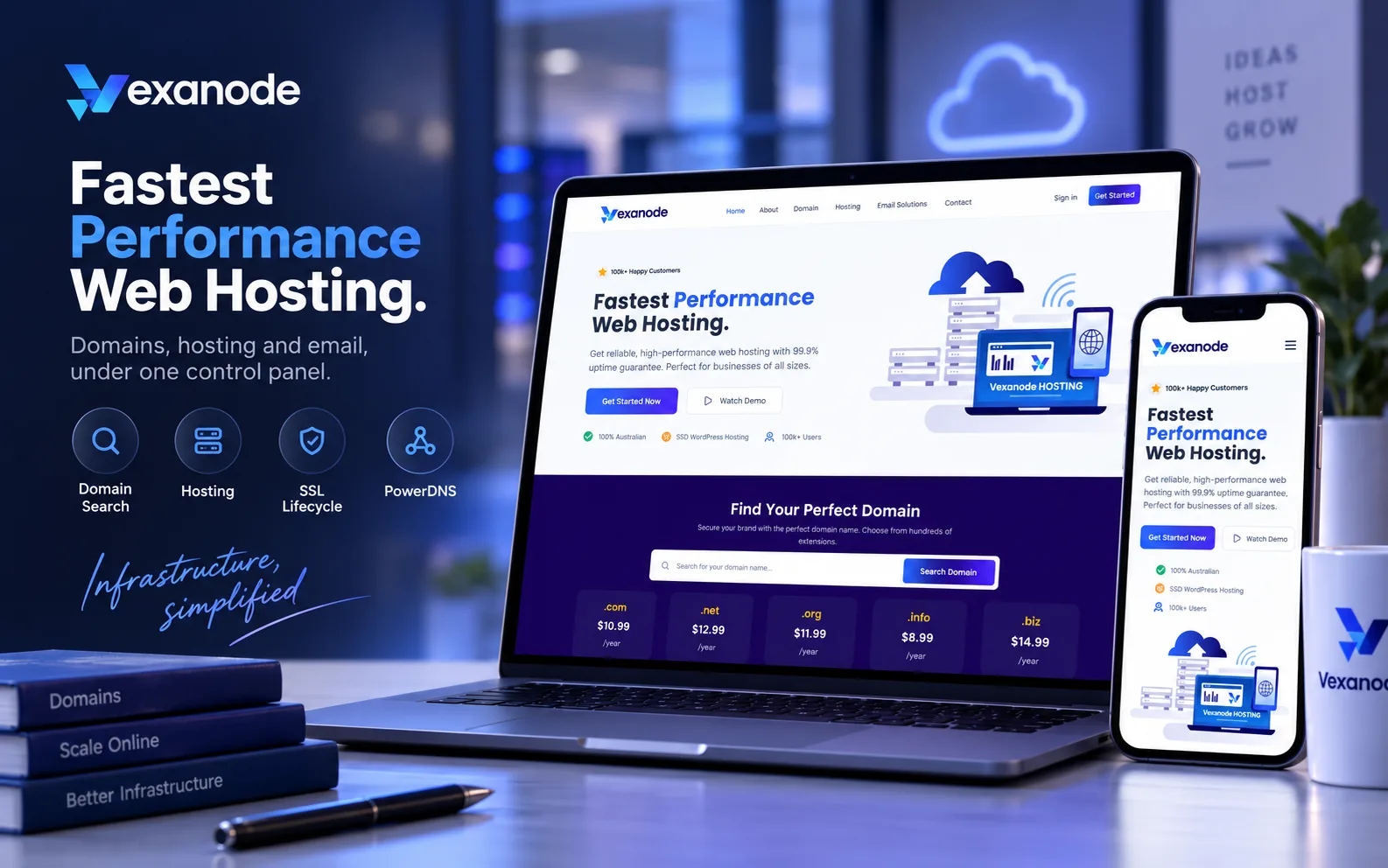
A hosting provider is two products wearing one brand. The front is commerce: domain search, transfer-in, a catalogue spanning shared, WordPress, premium, business and VPS hosting plus business email, and a checkout that provisions on payment. The back is infrastructure administration, where a mistyped record takes a site offline. We built the dashboard against that reality: DNS management integrated with PowerDNS so record changes propagate to real nameservers, SSL certificate lifecycle from issuance through renewal, service and hosting management across the product range, domain management covering registration, transfer and renewal, and an audit and activity log over all of it so any change is attributable after the fact. Around the transactional core sits the self-service layer that keeps support costs down: a knowledge base, support centre and FAQs, so the common question is answered before it becomes a ticket.
Selling Infrastructure Is the Easy Half
Every Dashboard Action Touches Something Live
A DNS record is not a form field. Changing it moves real traffic, and a bad write takes a customer offline. The control panel had to be built with that consequence in mind rather than as CRUD over a table.
Six Product Lines, One Provisioning Path
Shared, WordPress, premium, business and VPS hosting plus business email differ in what they provision but not in how they are bought. Divergence at checkout would have multiplied the surface area for billing bugs.
Support Cost Scales With Customers
Hosting margins do not survive a support ticket per customer per month. Self-service had to absorb the routine questions from the start.
How We Built It
DNS Against a Real Nameserver
Record management integrates with PowerDNS rather than storing records locally and hoping, so what a customer sees in the panel is what is actually resolving.
Certificate Lifecycle, Not Certificate Upload
SSL is managed as a lifecycle covering issuance, installation and renewal, because the failure mode that hurts is expiry, and expiry is a scheduling problem.
Provisioning Bound to Payment
Checkout, service creation and domain registration or transfer are a single path across all product lines, so a paid order and a provisioned service cannot drift apart.
An Audited Activity Trail
Every administrative action is logged, which is what lets support answer why a site went down at 2am without guessing.
What We Delivered
The Commercial Front End
Domain search and transfer, a hosting and email catalogue spanning six product lines, and a checkout that provisions on payment.
The Control Panel
DNS management over PowerDNS, SSL certificate lifecycle, service and hosting administration, and domain management including renewals and transfers.
Accountability
Audit and activity logging across administrative actions, so every change is attributable.
Self-Service Support
Knowledge base, support centre and FAQs, built to answer the routine question before it becomes a ticket.