Our role
We engineered Your Mellon as a two-sided system rather than a job board with an inbox. Candidates get curation that does the filtering work for them; employers get an applicant pipeline with the scheduling, task and note infrastructure that cross-border hiring actually requires.
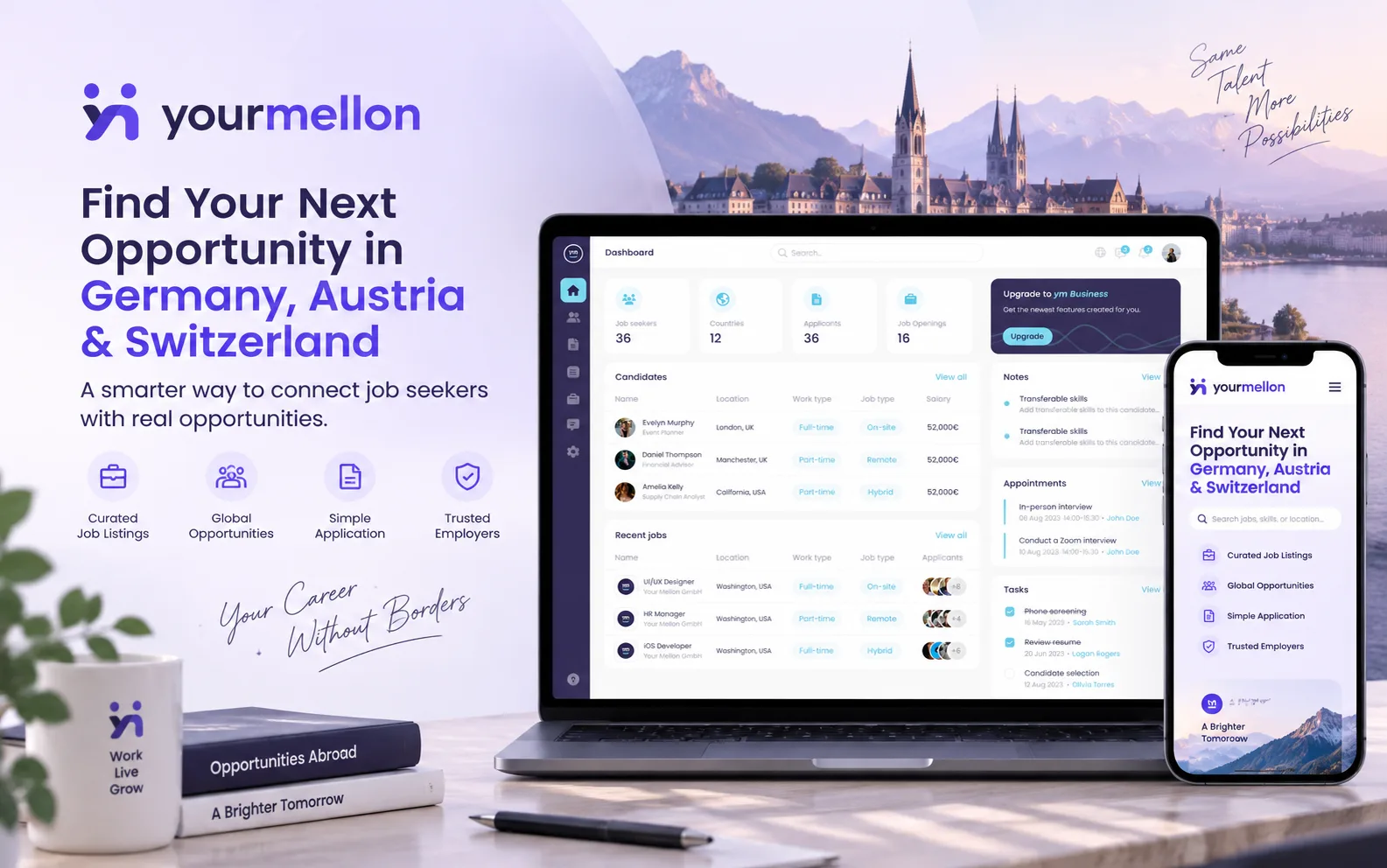
Cross-border hiring fails on the unglamorous parts. A candidate in one country cannot determine which listings will genuinely consider them, so they apply indiscriminately and are filtered out on signals nobody stated. An employer in another country tracks promising people across email threads until the thread goes cold. Your Mellon puts both sides on one platform with a shared pipeline state. On the candidate side, listings carry location, work type and working arrangement as first-class facets, so search narrows to what is genuinely open rather than what merely matches keywords. On the employer side we built an applicant tracking workspace: candidate records surfacing location, work type and compensation at a glance, appointment scheduling covering both in-person and video interviews, screening and review task lists, and free-text notes against each candidate for the transferable-skill judgements that structured fields cannot hold. A business tier sits alongside the free experience, so monetisation was an architectural assumption rather than a later migration.
Two Problems, One Platform
Candidates Cannot See Which Doors Are Open
Applying across borders means guessing at visa reality, language expectations and whether an employer considers international applicants at all. Curation had to absorb the work a generic job board pushes onto the candidate.
Employers Lose Good People to Administration
Inbound interest arrives faster than it can be tracked, and strong candidates go cold while someone reconstructs the history. The employer side needed to be a stateful pipeline, not a mailbox.
Skills Do Not Always Transfer on Paper
Someone demonstrably strong in one market reads as unqualified in another because the job title changed, not the ability. The data model had to leave room for human judgement.
How We Built It
Faceted Search Over the Real Decision
Location, work type and working arrangement are first-class facets rather than free-text fields, so a candidate narrows to genuinely viable opportunities instead of reading every posting to find out.
A Stateful Recruiter Workspace
Applicant tracking, interview scheduling for in-person and video, screening task lists and per-candidate notes share one pipeline state, so the status of a hire is queryable rather than reconstructed.
Structured Records, Unstructured Judgement
Free-text notes attached to candidates capture transferable skills and context that structured fields cannot represent, which is precisely what makes cross-border hiring work in practice.
Tiering Designed In
The employer experience was architected with a business tier alongside the free one, so commercial expansion did not require re-architecting the product afterwards.
What We Delivered
Candidate Discovery and Application
Curated listings with faceted search across role, location, work type and arrangement, a short application flow, and visible application status.
The Employer Pipeline
Job posting, applicant tracking with candidate detail at a glance, and portfolio-level metrics across seekers, openings, applicants and markets.
Interviews and Follow-Up
Appointment scheduling for in-person and video interviews, screening and review task lists, and structured notes recorded against each candidate.
Accounts and Commercial Tiers
Separate candidate and employer identities, with a business tier for teams hiring at volume.